





Why is Diwali celebrated 11 days later in Uttarakhand?
The festival is celebrated as Igas
The Sunday Mail
Dehradun. In Uttarakhand, Igas festival, or Old Diwali, is celebrated exactly 11 days after Diwali. Since this year Diwali fell on October 20th, Igas festival will be celebrated on November 1st. Celebrated in the mountainous regions, Igas Bagwal is a cultural heritage with its own special significance. In some places, it is also called ‘Budhi Diwali’. The purpose of this festival is not only to honor old traditions but also to keep Uttarakhand’s cultural heritage alive.
What are the beliefs behind the celebration of Igas?
The ancient belief behind the celebration of Igas is that the news of Lord Shri Ram’s return to Ayodhya reached Garhwal late, and in this joy, the people here celebrated their Diwali on Igas (Bagwal). It is also believed that during Diwali, people in the mountains are busy with farming, so it was customary to celebrate Igas with great pomp and show after completing their farming duties.
The brave warrior Madho Singh Bhandari returned victorious from the Tibet War.
There is also a belief that when the Garhwali soldiers, led by the brave warrior Madho Singh Bhandari, returned to their village 11 days after Diwali after their victory in the Tibet War, they celebrated the festival by lighting lamps, which is now celebrated with great pomp and show as Igas.
The song “Barah Ae Gaini Bagwali, Mero Madhi Ni Aayi” is associated with Madho Singh Bhandari, the commander of the Garhwal state. This story dates back to the time when King Mahipati Shah ruled the Garhwal state, and Tibet was the state’s biggest enemy. King Mahipati Shah of Garhwal sent his commander Madho Singh Bhandari to fight the Tibetan king. He also ordered Madho Singh to return to Srinagar with his army by the day before Diwali. Upon receiving the king’s permission, Madho Singh, along with his army, went to fight the Tibetan king and won the battle.
Madho Singh won the battle, but news of this did not reach the Garhwal state until Diwali. Due to the lack of any news by Diwali, rumors spread that the Garhwali army had been killed in the battle. The king also assumed that his army had been killed. Consequently, the king announced that Diwali would not be celebrated in the state this year. Deeply mourned, Garhwal remained silent. However, joy returned when news arrived that Madho Singh Bhandari had won the Tibet war and would soon arrive in Srinagar with his army. The king then announced that Diwali would only be celebrated when Madho Singh Bhandari arrived in Srinagar. Eleven days after Diwali, he arrived in Srinagar, and on that day, the entire state was decorated like a bride, and Diwali was celebrated throughout the state. Since then, the “Igas Bagwal” tradition began in Garhwal.
Main Attraction: Bhailo Game
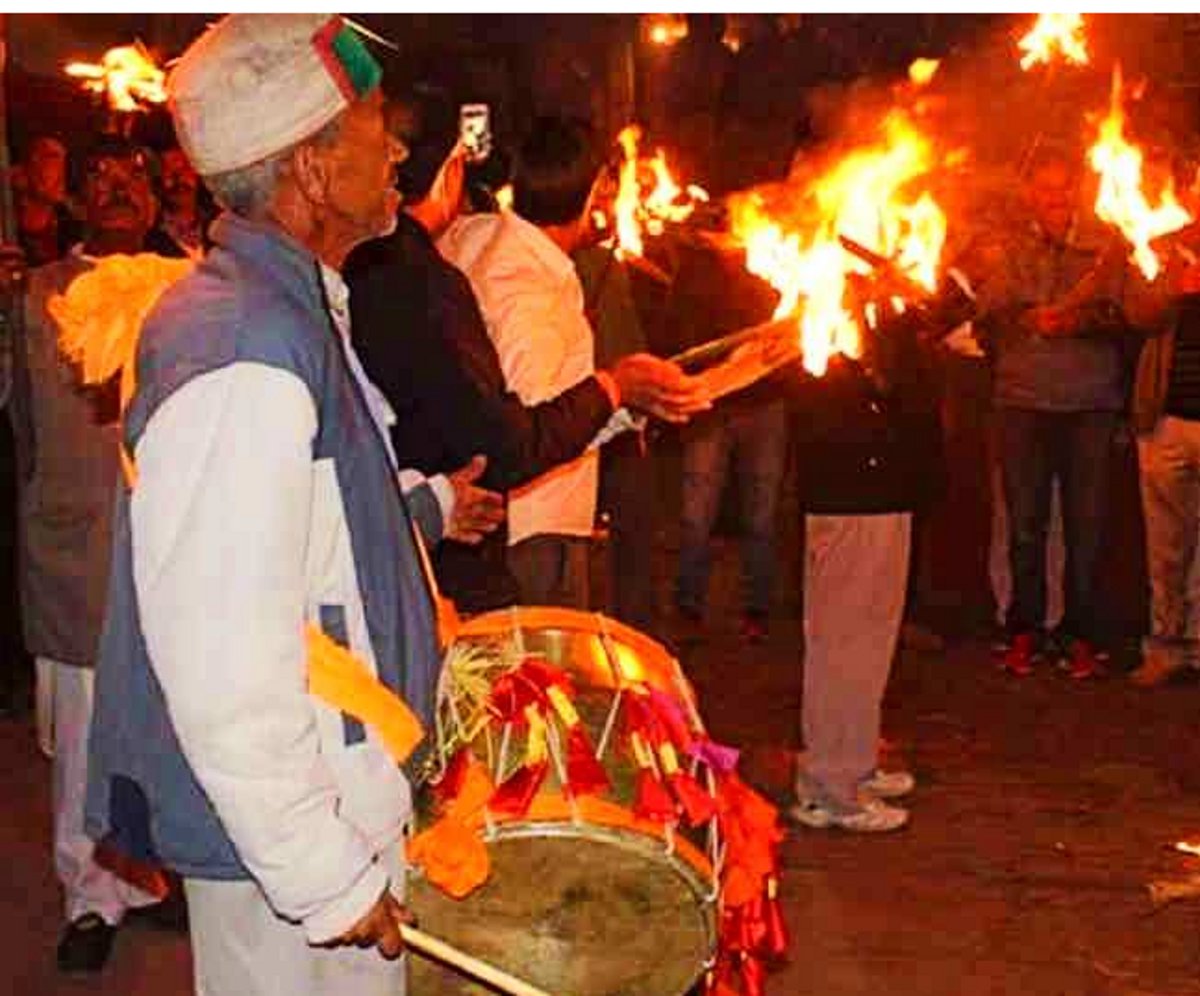
The main attraction of the Igas festival is the Bhailo Game. In this game, torches made of pine wood, called Bhailo, are lit and rotated while folk songs and dances are performed. People sing traditional songs like “Bhailo Re Bhailo,” “Kakhri Ko Railue,” and “Ujyalu Alo Andhero Bhaglu.” It is believed that by doing so, Goddess Lakshmi removes all suffering and bestows happiness and prosperity. Songs are sung while playing Bhailo, and dances like “Chanchhadi” and “Jhumelo” are also performed. Igas is also an environmentally friendly festival, as firecrackers are used sparingly. Sweet dishes are prepared in the morning on the day of Igas, or old Diwali. After worshipping local deities at night, Bhailo, a type of torch, is lit and rotated, and folk dances are performed around the fire accompanied by drums and cymbals.
Auspicious events begin with the Igas festival.
Igas, also known as Haribodhini Ekadashi, Old Diwali, or Igas Bagwal, also means Ekadashi, and is celebrated on the eleventh day of the month of Kartik. On Igas, Lord Vishnu awakens from a four-month yogic sleep. This is an auspicious time for beginning new endeavors. Auspicious events, including marriages, also begin on this day.
Cattle are worshipped. Cattle are prepared with rice, jhangora, bari, and manduva. First, the cattle’s hands and feet are washed and they are worshipped by lighting lamps and incense. A turmeric mark is applied to their foreheads and mustard oil is applied to their horns, and they are given food grains arranged in a plate, known as Gogras.