





Dr. Satish Poonia’s Maiden Speech in Rajya Sabha
Transparent and Accountable Tribunal System to Boost Public Confidence
The Sunday Mail
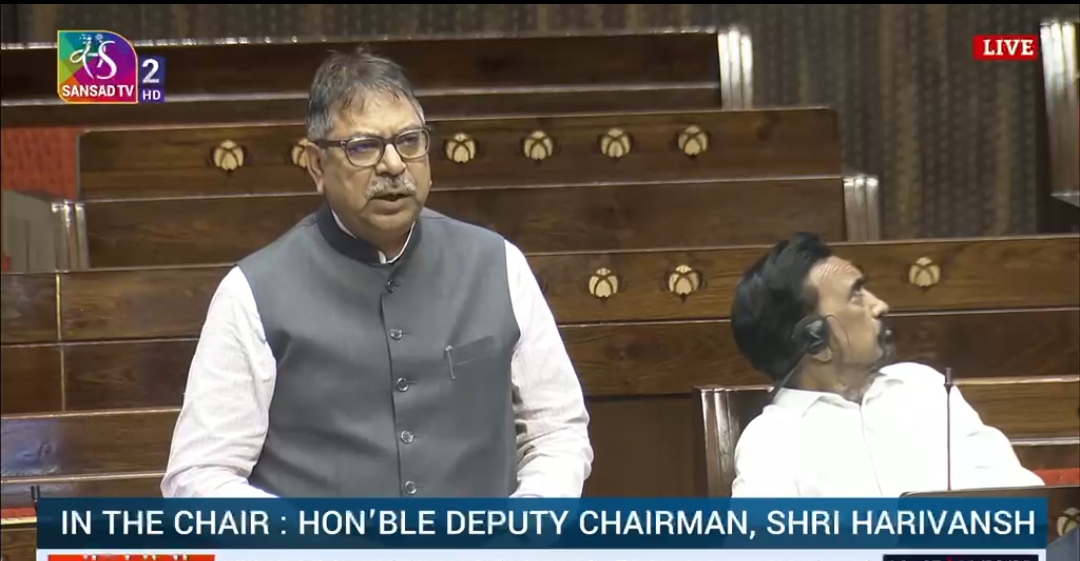
New Delhi: On Tuesday, MP and Haryana BJP in-charge Dr. Satish Poonia delivered his maiden speech in the Rajya Sabha following his election to the House, speaking on the Tribunal Reforms Bill-2026. Dr. Poonia described the bill as a significant initiative aimed at making the tribunal system organized, transparent, impartial, and accountable. The Rajya Sabha passed the Tribunal Reforms Bill-2026 on Tuesday.
Dr. Poonia stated that the objective of the Central Government, led by Prime Minister Narendra Modi, is to provide convenience to the common man while ensuring timely access to justice. In a democracy, the common citizen expects justice, but merely receiving justice is not enough; it must be delivered in a timely, impartial, and transparent manner, and public trust in the entire judicial system must be upheld.
**Mention of 5.24 Lakh Pending Cases**
Outlining the background of the tribunal system, Dr. Poonia noted that various tribunals have been operating across different sectors in the country. Cases have been heard through distinct tribunals in areas such as taxation, corporate affairs, environment, armed forces, telecommunications, debt recovery, stock markets, and administration. He remarked that the large number of pending cases in tribunals hampered the judicial process. Citing the figure of approximately 5.24 lakh pending cases, he described this as a major challenge facing the government. He pointed out that in 2018, there were 37 tribunals functioning in the country, linked to 18 different ministries; the Ministry of Finance alone oversaw 12 tribunals. Disparities in the functioning and capacity of these various tribunals also gave rise to several practical challenges. **Emphasis on Transparency and Accountability in Appointments**
Dr. Poonia stated that the Bill seeks to make appointments within the tribunal system more transparent and time-bound. Describing the establishment of the National Tribunal Commission as a significant initiative, he noted that it would bring transparency to both the appointment process and the administrative framework.
He pointed out that prolonged vacancies in the posts of chairpersons and members lead to delays in case disposal. Timely appointments would enable tribunals to function at full capacity and accelerate the resolution of pending cases.
Dr. Poonia also highlighted the importance of expert participation in tribunals. He remarked that the presence of experts with extensive experience in technical, financial, and commercial matters would enhance the effectiveness of the decision-making process. Decisions based on such expertise are likely to be more effective and aligned with the ground realities of the respective sectors.
**Monitoring via National Tribunal Grid**
Referring to the National Tribunal Grid, Dr. Poonia stated that this system would prove useful for monitoring tribunal operations and improving data management. Having data on pending cases, disposed cases, vacancies, and other critical information available on a single platform would help identify the resource requirements of specific tribunals and pinpoint areas needing improvement.
He added that a data-driven system would facilitate a better evaluation of tribunal performance, enabling future policies and administrative decisions to be based on actual data.
**Impact of Judicial Reforms on the Economy**
Dr. Poonia emphasized that tribunal reforms should not be viewed solely within the context of the judicial system; they also have a direct bearing on the country’s economy. In his address, he claimed that capital worth approximately ₹24.72 lakh crore is currently locked up due to pending cases in tribunals. Timely resolution of these cases would unlock this capital and provide momentum to economic activities.
He concluded that if tribunals operate at full capacity and resolve cases in a timely manner, it would provide a positive boost to business, investment, and economic activity. In this regard, tribunal reform represents a significant step towards both judicial and economic reform.
**Boosting Public Confidence in the Judicial System**
Poonia stated that public trust is the ultimate benchmark for the success of any judicial or administrative system. If the common citizen is assured that their grievance or dispute will be resolved impartially and in a timely manner, their faith in democratic institutions will be further strengthened.
He remarked that the Tribunal Reforms Bill is not merely a law to streamline hearing procedures; it is expected to bolster accountability, transparency, expertise, and the delivery of timely justice. According to him, reforming the constitution and functioning of tribunals within Indian democracy will enhance public confidence in the judiciary and the tribunal system.
**Linking Judicial Reform to the Goal of a Developed India**
Highlighting the Modi government’s public welfare initiatives, Dr. Poonia noted that schemes such as Jan Dhan, Ujjwala, Ayushman Bharat, and Awas have brought about transformative changes in the lives of ordinary people. He added that, under the leadership of Prime Minister Narendra Modi, the country demonstrated its capabilities even during challenging times like the COVID-19 pandemic.